
May 10,2026
Plans for building your own DIY supCAT start with an oversize piece of paper and a grid of one inch squares.
I have a 'default' set of shapes for the internal bulkheads. But, the builder can still choose to design their own set of shapes. The idealized, most common shape of a pontoon is a long, tapered, narrow shape ending at pointed bow and stern, which by the way, implies that both ends are identical.
This is a design choice. The beauty and curse of 'building your own' is the near infinite number of design 'choices' for the builder to decide upon.
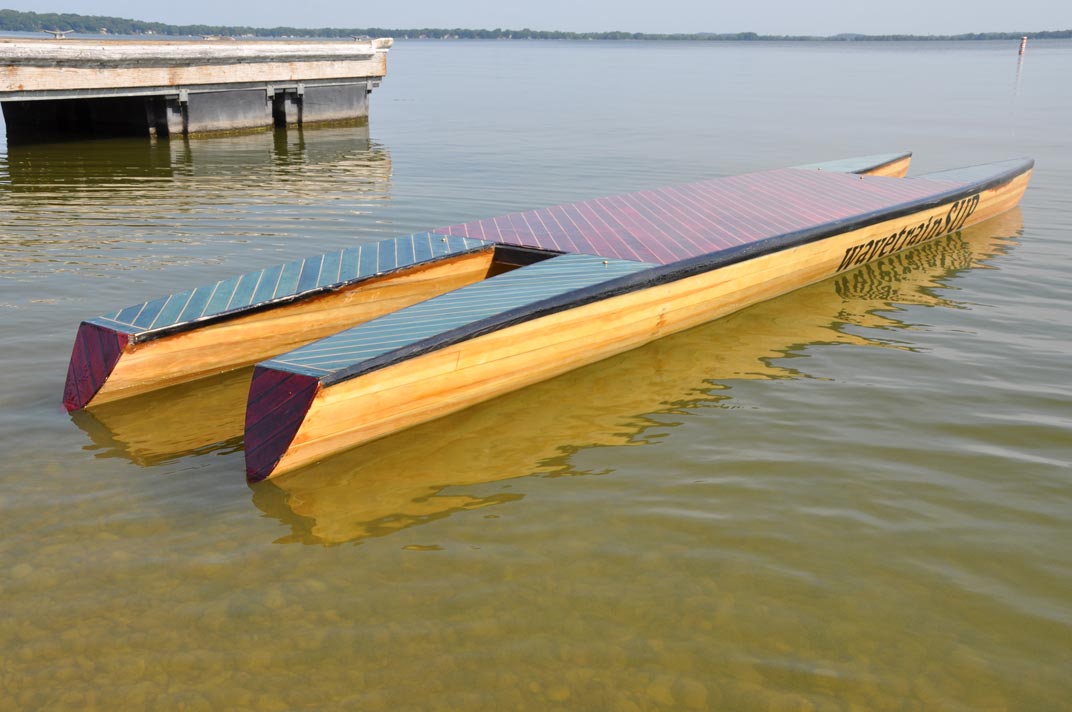
It is this set of planned bulkhead shapes that make the supCATs outline AND profile, and more importantly, create the internal volume (void) which provides the buoyancy to 'float' the planned load. Imagine the ominous sound of rolling thunder here, because there are devils found in these simple details. Both kit and plan set come with a book detailing how I go about resolving these details, which resulted in the blue and red supCAT that remains my main 'in use' supCAT.
Back to that piece of one-inch grid paper. There needs to be a known volume of air contained in the pontoon set. A volume with a high degree of confidence attached to it. It is this volume of air, after all, that will float the weight that is on the deck. One cubic foot of air will float 62.4 ponds of 'weight' in FRESH water. 64 pounds in salt water. It is hard to draw that in 2D. Much easier to draw 1,728 cubic inches that one cubic foot. That is the point of the one inch grid paper. Then, once the 2D is known, you can loft that shape into 3D and arrive at the internal volume.
But it doesn't stop there. The tapered ends make volume calulation much more difficult. My work around is making the non-tapered center chunk large enough to float the planned weight, and the tapered end segments then provide the freeboard volume. This has worked pretty well so far.
Here, it must be pointed out that the above number DOES NOT include freeboard! That one cubic foot will float the weight flush to the water surface.
How is a plan different from a kit? A plan is logical and virtual, while a kit is physical. A kit includes the pre-cut wood pieces, while a plan explains how to do the cutting and offers none of the wood. You have to source everything, buy it, cut it, and store it. So the difference is large between plan and a kit!
Questions tend to revolve around the pontoons. The issue and choice of how to shape a pontoon, such that it gradually tapers to the bow and stern, and calculating the volume of a pontoon so the builder can zero in on an overall size of the pontoon in order to get enough buoyancy to float the paddler. Truly a mouthful. It's manageable, but the best custom answer that best fits each builder/paddler requires a bit of math, pretty much back of the envelope calculating. The answers to those questions are in the set of plans and are translated into a set of drawings that can be all you need to build your own, OR can be a starting point for you to create your ‘one of a kind’ pontoon-based supCAT or catasup, or padamaran, or whatever you choose to call it.